Case study · Personal project, 2026
Sentien
UX research run with AI, judged by a human.
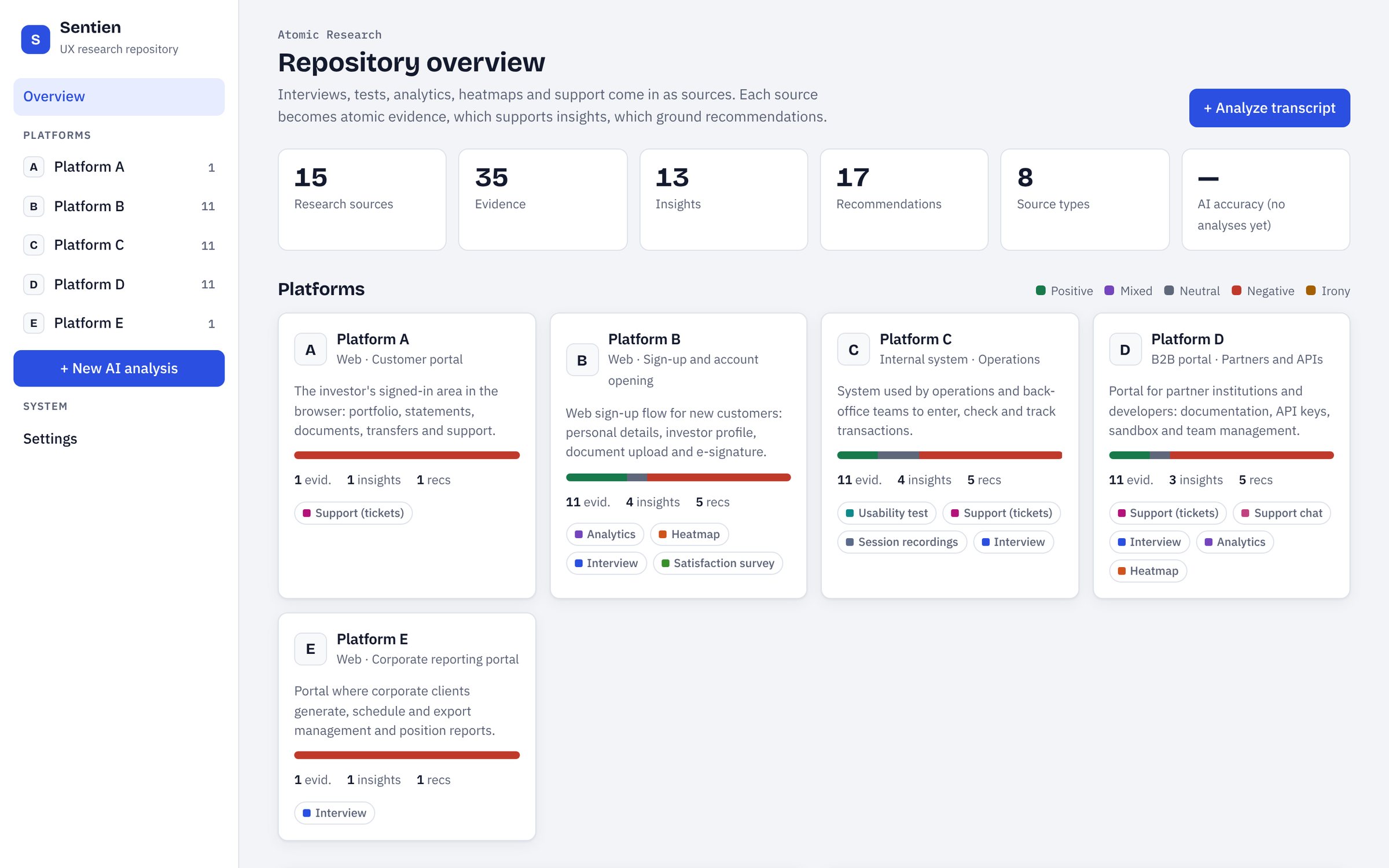
Overview
Sentien is a UX research repository operated by AI, with human judgment deciding what the AI gets right and wrong.
It turns interviews, tests and other sources into traceable evidence, so every product recommendation can be followed back to the exact quote or number behind it.
The problem
In companies with complex systems, UX research is scattered. Interviews live in recordings, usability tests in reports, analytics and heatmaps in their own tools, support tickets and satisfaction surveys with other teams. Each source tells part of the story, and nobody puts the parts together.
That costs three things:
- Lost knowledge. Reports are read once and forgotten, and research gets repeated because nobody can find what was already learned.
- Decisions without a trail. A recommendation reaches the product team with no way back to the quote or data behind it, so the discussion becomes opinion against opinion.
- Heavy operational work. Transcribing, splitting quotes, tagging and tabulating eat the time a designer should spend analyzing.
Who it's for
- Primary: UX designers and researchers in companies with several systems, where each person owns one part (website, internal tool, B2B portal). That is where knowledge fragments the most.
- Secondary: product managers, tech leads and managers who need to decide on evidence and want to see where each recommendation comes from.
It is not for a small team with one product and one designer. There, a well-organized document does the job, and a repository becomes bureaucracy.
How it works
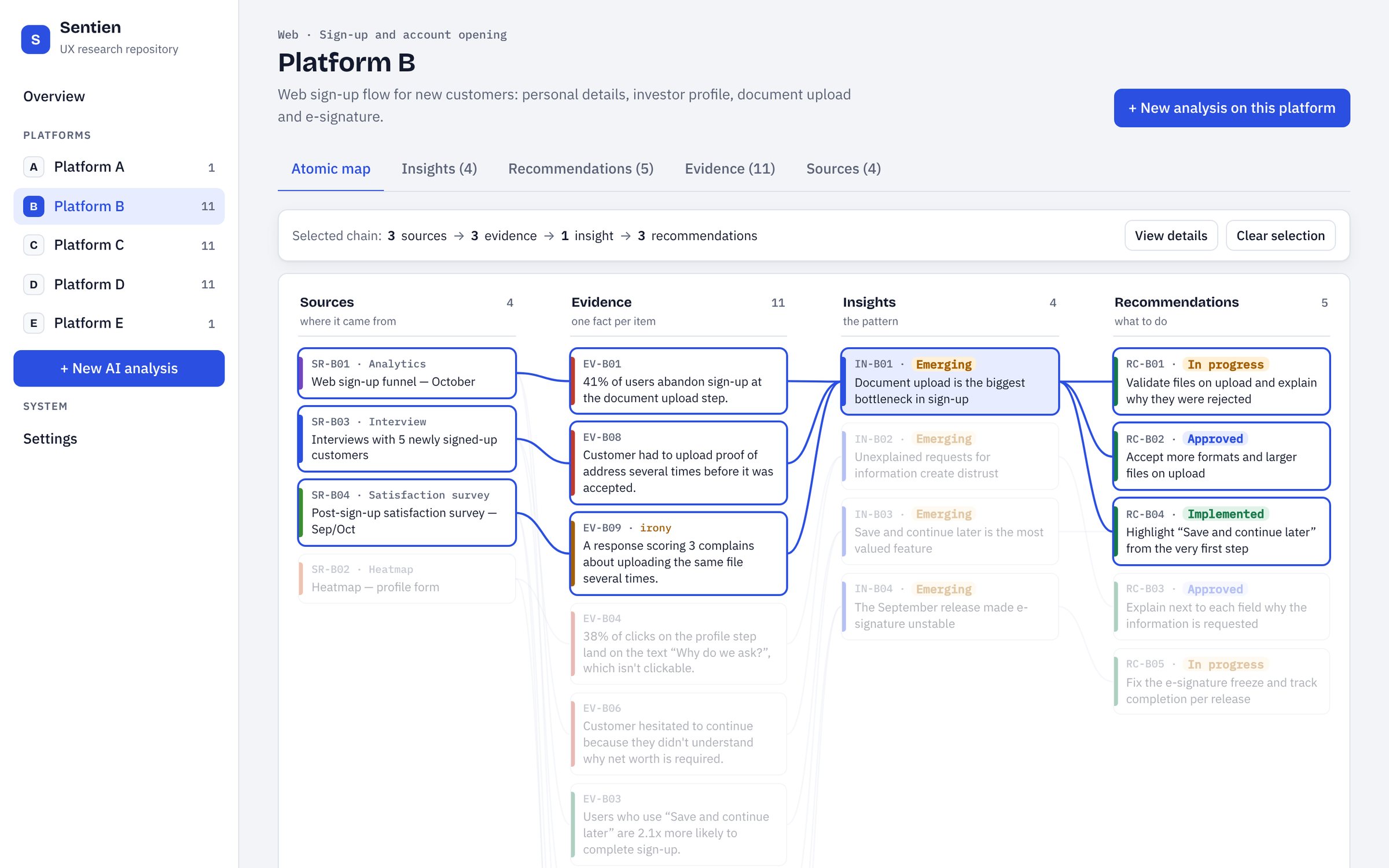
Sentien follows the Atomic Research model. Each layer links to the one before it, so any recommendation can be traced back to its sources.
- Source: an interview, usability test, analytics report, support ticket or survey.
- Evidence: one atomic observation per item, a single quote or data point.
- Insight: a pattern that several pieces of evidence point to, rated by strength (Hypothesis, Emerging or Validated) depending on how many pieces of evidence and how many types of source support it.
- Recommendation: an action for the product team, with a status that tracks it to implementation.
Evidence and insights link many-to-many: one quote can support several insights, and one insight gathers evidence from different sources.
AI proposes, I decide
The AI does the operational work. Nothing enters the repository without human validation.
| The AI | Me |
|---|---|
| Reads the transcript and separates the participant's words from the researcher's questions | Approves, edits or rejects every piece of evidence |
| Breaks each answer into atomic evidence, one idea per item | Catches what the AI misses, especially subtle irony and context |
| Tags sentiment, feedback type, theme, severity and region | Decides whether a pattern is a new insight or reinforces an existing one, and names it |
| Flags possible irony and explains why | Moves each recommendation through its status: Proposed, Approved, In progress, Implemented |
| States its confidence and justifies each tag | Designed the system's rules: taxonomy, insight strength levels and the confidence threshold below which the AI asks for attention |
| Suggests whether evidence supports an existing insight or needs a new one, and drafts a recommendation | Accepts new insights only when at least one piece of their evidence has been approved |
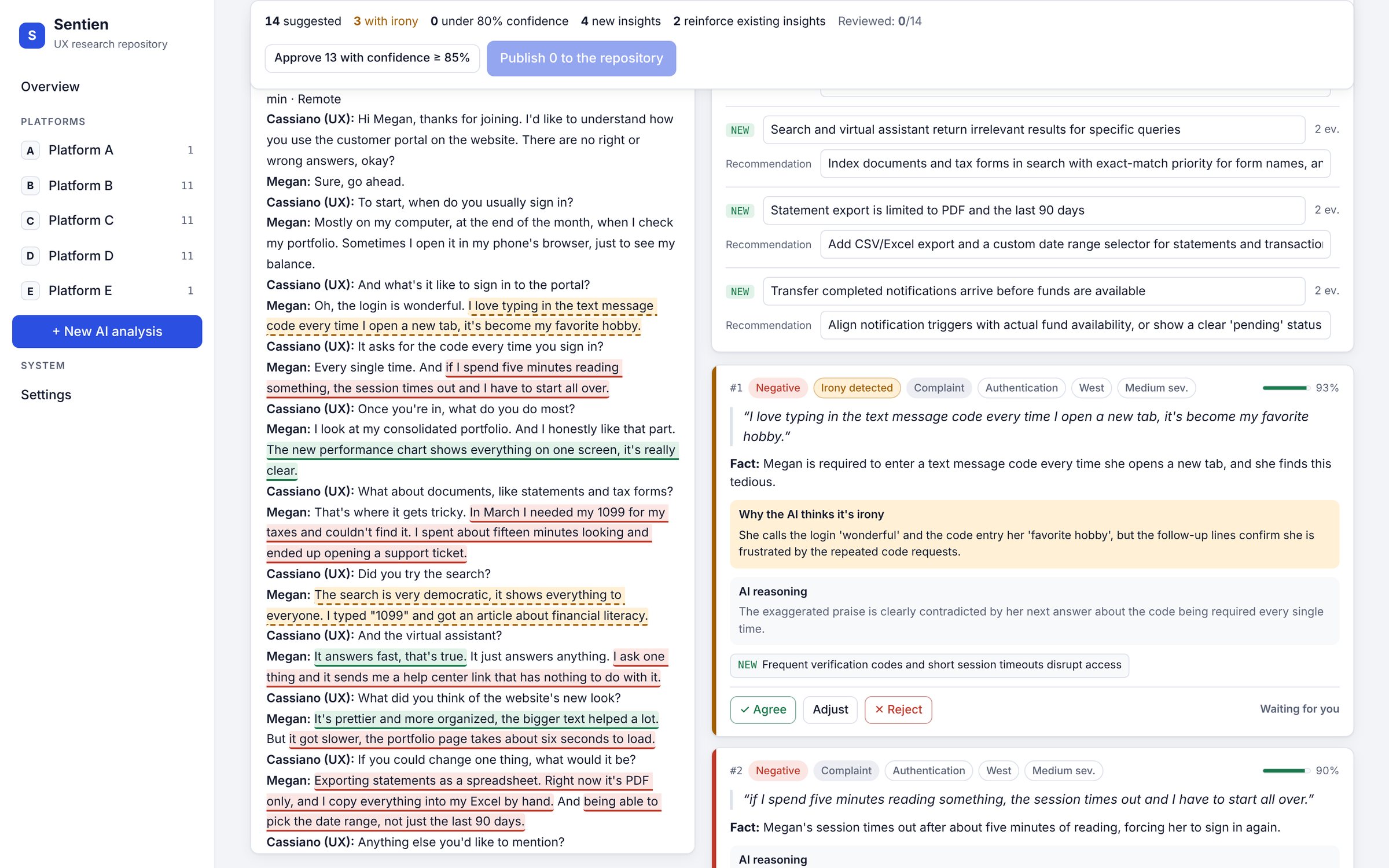
An example of what the AI can miss:
"The search is very democratic, it shows everything to everyone."
Word by word, it reads as praise. It is a complaint about irrelevant results.
From transcript to repository
One interview becomes linked evidence in four steps. Each step carries a design decision that keeps the researcher in control.
- Upload. The researcher picks the platform and drops in a transcript: .docx, .pdf, .txt, .rtf, or the .vtt and .srt captions exported from Teams, Zoom or Meet. Pasting text also works.
- Review. The AI's suggestions appear next to the transcript, each with a confidence meter. Anything under 80% is flagged "Review carefully". The researcher can agree, adjust or reject each piece of evidence, and can approve in bulk only what the AI rates at 85% or higher.
- Commit. Only approved evidence enters the repository. A new insight the AI proposed is kept only if at least one of its pieces of evidence was approved. Rejected quotes stay on the source, struck through, so the decision is visible later.
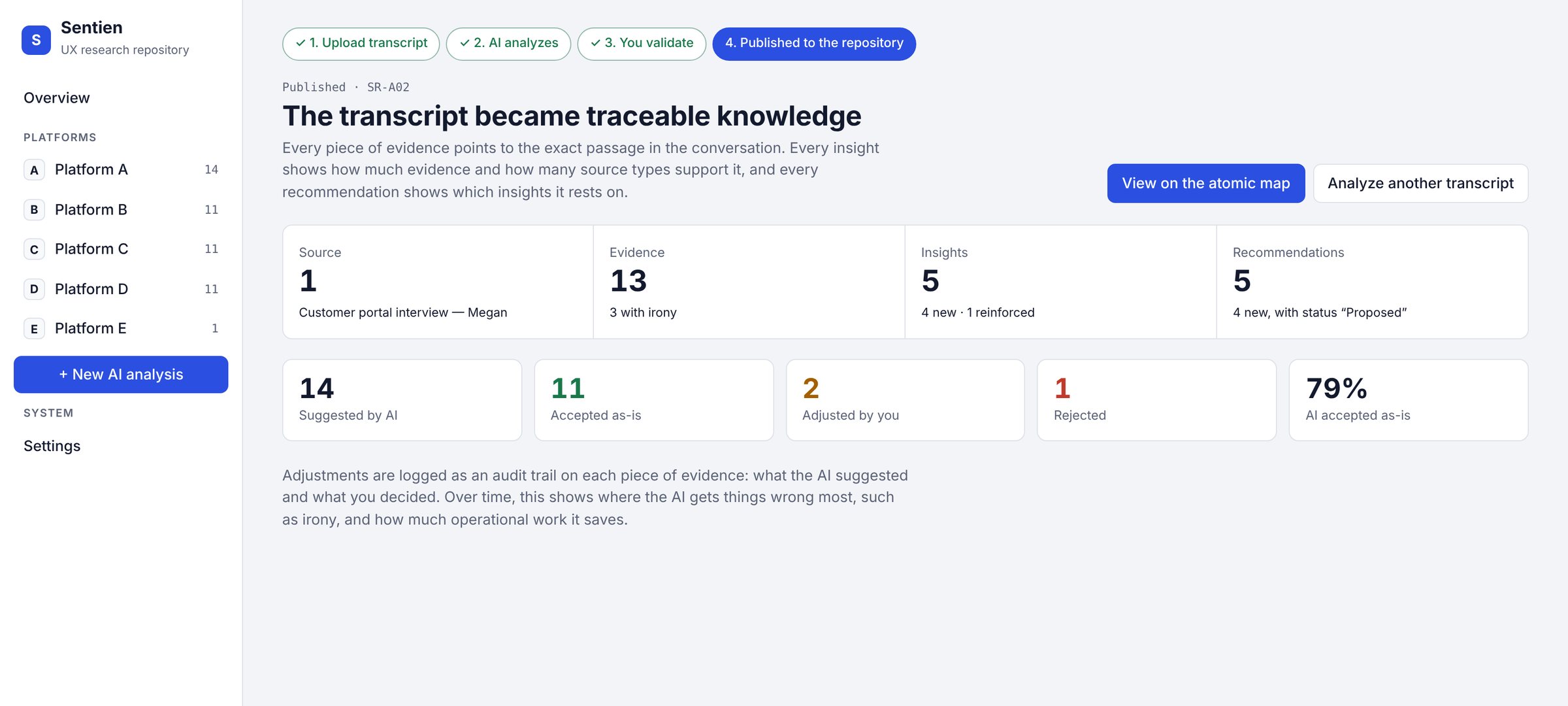
- Trace. The result screen counts what the AI suggested, what was accepted as-is, adjusted or rejected, and the share the AI got right without help. From there, the atomic map lights up the full chain from any item: source, evidence, insight, recommendation.
A test run
On Megan's fictional interview, the AI suggested 14 pieces of evidence and flagged 3 as irony, including the "very democratic" search. I adjusted two: a polite "it answers fast" that set up a complaint, and a theme the AI got wrong. I rejected one that only repeated another quote's frequency.
The scenario
The case uses five fictional platforms of a US investment company: a customer portal, a sign-up and account opening flow, an internal operations system, a B2B partner portal and a corporate reporting portal. It holds 15 sources of eight types, 35 pieces of evidence, 13 insights and 17 recommendations. No real company or user data is involved.
The central design decision: an audit trail
Every adjustment I make is logged: what the AI suggested and what I decided. That makes the AI's errors visible and measurable instead of hidden. Over time, the log shows where the AI can be trusted and where human review must stay.
What I learned
- The value is traceability, not the AI. What made the concept click was the atomic map: clicking an insight and seeing different types of source arrive at the same conclusion. The AI speeds things up; the chain of evidence is what convinces.
- The AI fails exactly where it matters. Irony and context separate a good synthesis from a bad one. Human validation is part of the product, and the AI's stated confidence shows where to look harder.
- Simplifying the method has a cost. The first version linked each piece of evidence to a single insight and treated recommendations as loose text. It worked in a demo but would not survive someone who knows Atomic Research. Many-to-many links and recommendations with status made the model credible.
- Scale changes the design. In an earlier, larger version, one platform reached 90 pieces of evidence, and a map that worked with 10 became a wall. A real repository has to be designed for that volume; this case shows a smaller slice so the chain can be read.
- A realistic scenario convinces more than a didactic one. Removing demo scaffolding and using a fictional world close to reality, with no sensitive data, made the platform more believable than explanatory examples.
Status and what I would measure next
Sentien is a working prototype with a simulated scenario. The first test run accepted 79% of the AI's evidence without changes, but one interview is a data point, not a measurement. In real use, I would measure:
- AI accuracy without adjustment: the share of evidence approved as proposed.
- Time from conversation to published insight.
- Recommendations reaching "Implemented": whether research actually changes the product.
Most of my client work is under confidentiality. I am happy to walk you through it in a call.
Request work samples